
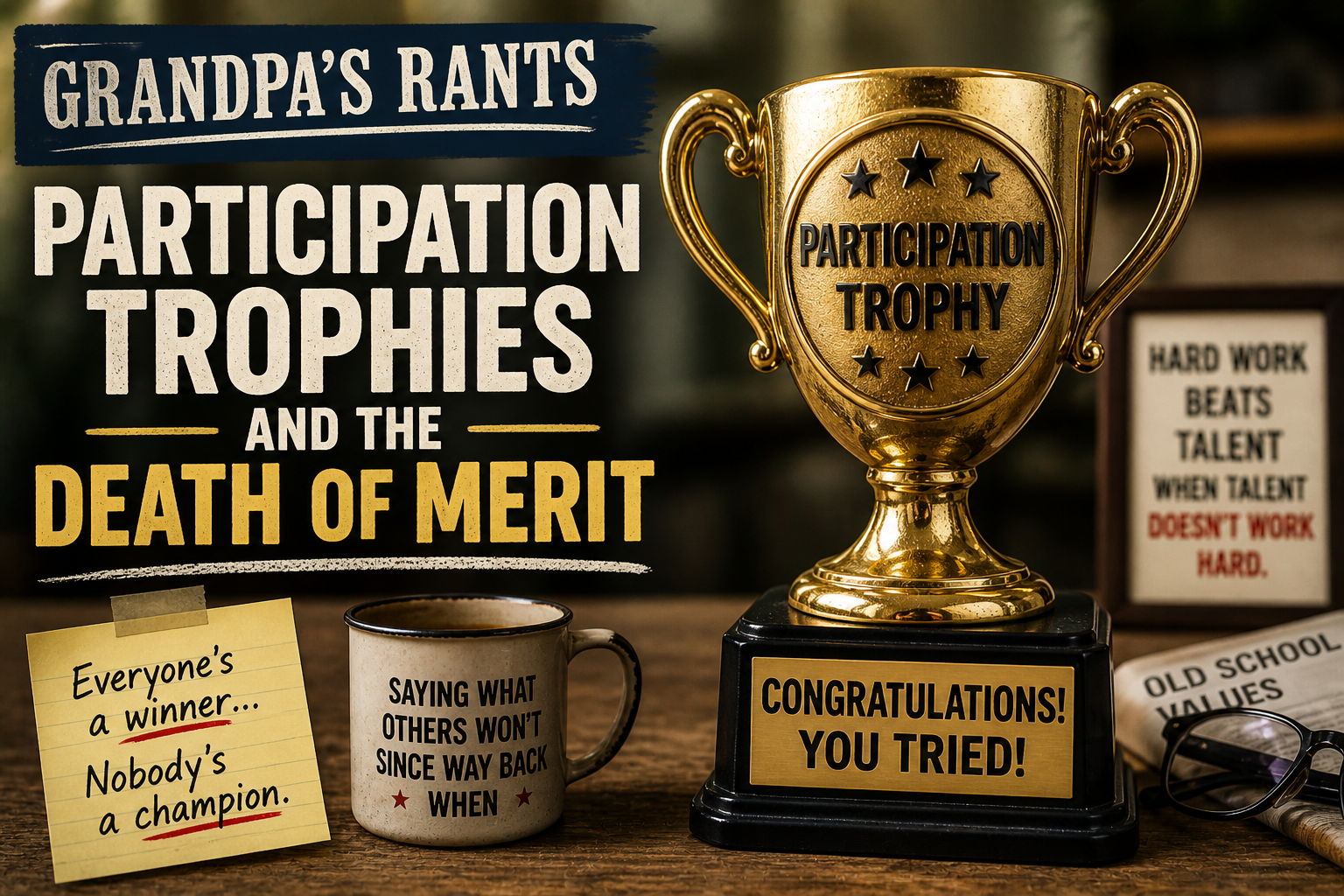
Now gather ‘round, kids, pull up a chair, grab a cup of coffee (or whatever watered-down nonsense passes for coffee these days), because Grandpa’s got something to say.
Participation trophies.
Yeah, I said it.
Back in my day, and I know, I know, here we go again, but stick with me, back in my day, you got a trophy for winning. Not for showing up. Not for tying your shoes correctly. Not for “trying really hard and having a positive attitude.” You won, you earned it, you got the hardware. You lost? You got a handshake, maybe a pat on the back, and a healthy dose of motivation to do better next time.
And guess what? We survived. Somehow, against all odds, we managed to go on living without a shelf full of shiny reminders that we came in seventh place.
Now? Everybody gets a trophy. First place, last place, kid who spent half the game picking dandelions in the outfield, it’s all the same. You show up, you leave with a medal like you just conquered Mount Everest.
Let me tell you something, that’s not encouragement. That’s confusion.
Because when everything is rewarded, nothing means anything anymore.
You think you’re building confidence? No. You’re building an illusion. You’re telling kids that effort and outcome are the same thing, and they’re not. Effort matters, sure, but results matter too. That’s just how life works. You don’t get promoted at work for “participating.” You don’t get paid extra for “almost” doing your job.
Can you imagine a surgeon saying, “Well, I didn’t quite remove the appendix, but I showed up and gave it a shot, where’s my trophy?”
Yeah, no thanks. I’ll take the guy who actually knows what he’s doing.
And here’s the real kicker, kids aren’t dumb. They know when something’s not earned. You hand a kid a trophy they didn’t earn, and deep down, they know it. It doesn’t build pride, it cheapens it. Real pride comes from overcoming something. From working hard, failing, getting back up, and finally getting it right.
That’s the good stuff. That’s what sticks with you.
We’ve taken losing, something that used to teach resilience, grit, and humility, and turned it into something to be avoided at all costs. Heaven forbid little Johnny learns he’s not the best at something. Guess what? None of us are the best at everything. That’s called reality, and the sooner you learn it, the better off you’ll be.
Losing isn’t the enemy. Quitting is.
But instead of teaching kids how to handle defeat, we wrap them in bubble wrap and hand them a ribbon. We’ve created a world where feelings matter more than facts, where effort gets the same reward as excellence, and where nobody’s allowed to stand out because it might make someone else feel bad.
Well, here’s a thought, maybe we should celebrate excellence. Maybe we should recognize hard work, discipline, and achievement. Not to tear others down, but to show what’s possible.
Because merit matters.
It matters in school.
It matters in work.
It matters in life.
And when you blur that line, when you tell everyone they’re a winner no matter what, you don’t lift people up, you lower the bar.
Now don’t get me wrong, I’m not saying kids shouldn’t be encouraged. They absolutely should. Cheer them on, support them, teach them, help them grow. But don’t lie to them. Don’t hand out fake victories and expect real confidence to follow.
Confidence isn’t given. It’s earned.
Same as respect. Same as success.
So maybe it’s time we bring back a little old-school thinking. Let winners win. Let losers learn. Let effort be praised, but let achievement be recognized.
Because if everything’s a trophy… then nothing is.
And that, my friends, is how you end up with a whole generation wondering why the real world doesn’t hand out medals just for showing up.
That’s enough outta me for now. But don’t worry, I’ve got plenty more to say next time.
– Grandpa (Professional Ranter and Amateur Philosopher)



👍